







If a child is blind, no one considers it cheating to provide them with materials in Braille. If a child is hearing impaired, no one would consider it cheating to provide them with access to learning through signing. The question itself then implies the assumption that ADHD is not a disability. Unlike blindness or deafness, attention deficits that impact learning are invisible to those who choose not to recognize them.
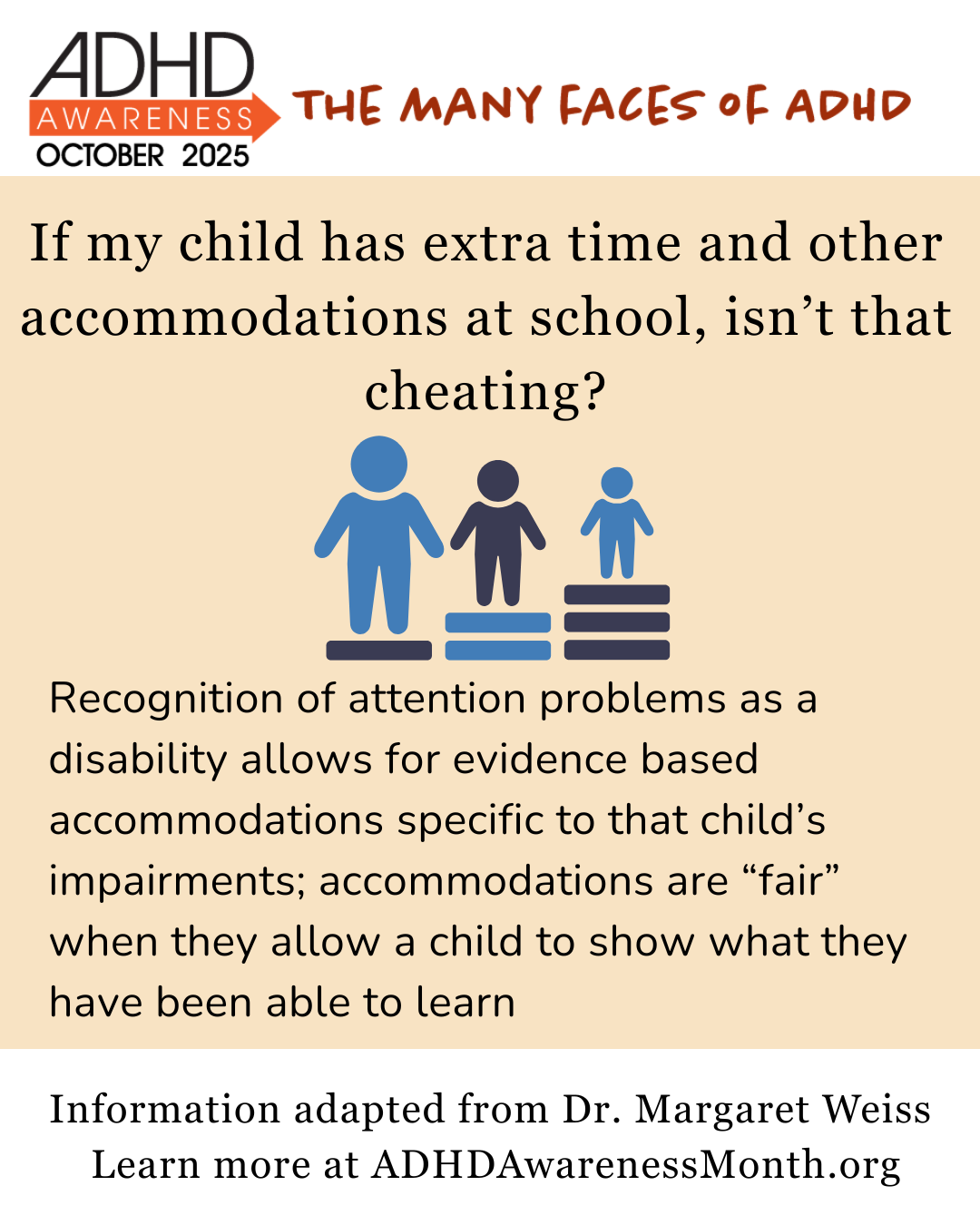
Recognition of attention problems as a disability allows us to make specific and evidence based accommodations specific to that child’s impairments. Note that this does not mean there is one IEP that fits all children with ADHD.
A child with a specific problem with processing speed should be given the time needed to show what they know and have their academic achievement measured by what they can do, and not by the limitations imposed by processing delay.
A child with dysgraphia should be given the opportunity to learn to keyboard, dictate, or have a scribe.
A child who cannot organize should be given the opportunity to have extra books at home, or flexibility with turning in assignments.
A child who cannot work in the evening off stimulant medication, should be given the opportunity to complete work in the classroom, under supervision, and on medication.
All accommodations are “fair” when they allow a child to show that they have been able to learn as another child who does not struggle with the same challenge. 504 or IEP plans that provide a blanket set of core recommendations for all children with ADHD, without attention to their specific difficulties, are unlikely to be helpful. By the same token, however, neither do they provide any advantage. If a child, any child, does much better at showing what they know when given extra time, the problem is in the test, not the accommodation.
About the Author

Dr. Margaret D. Weiss, MD, PhD, FRCP(C), is the Director of Clinical Research in Child Psychiatry at Cambridge Health Alliance. She specializes in ADHD and neurodevelopmental disorders across all age groups. She earned her MD and Psychiatry Fellowship from McGill University and a PhD in History of Science from Harvard University. Dr. Weiss has published over 125 peer-reviewed articles, authored ADHD-related book chapters, and co-authored ADHD in Adulthood, which is being revised. She is recognized for her research on melatonin for treating insomnia in ADHD and created the widely-used Weiss Functional Impairment Rating Scale. Dr. Weiss has lectured in over 21 countries and previously directed ADHD and child psychiatry programs in British Columbia and Arkansas. She also serves on advisory boards for ADHD-related organizations.
References
- Lovett BJ, Nelson JM. Systematic Review: Educational Accommodations for Children and Adolescents With Attention-Deficit/Hyperactivity Disorder. J Am Acad Child Adolesc Psychiatry. Jul 31 2020.